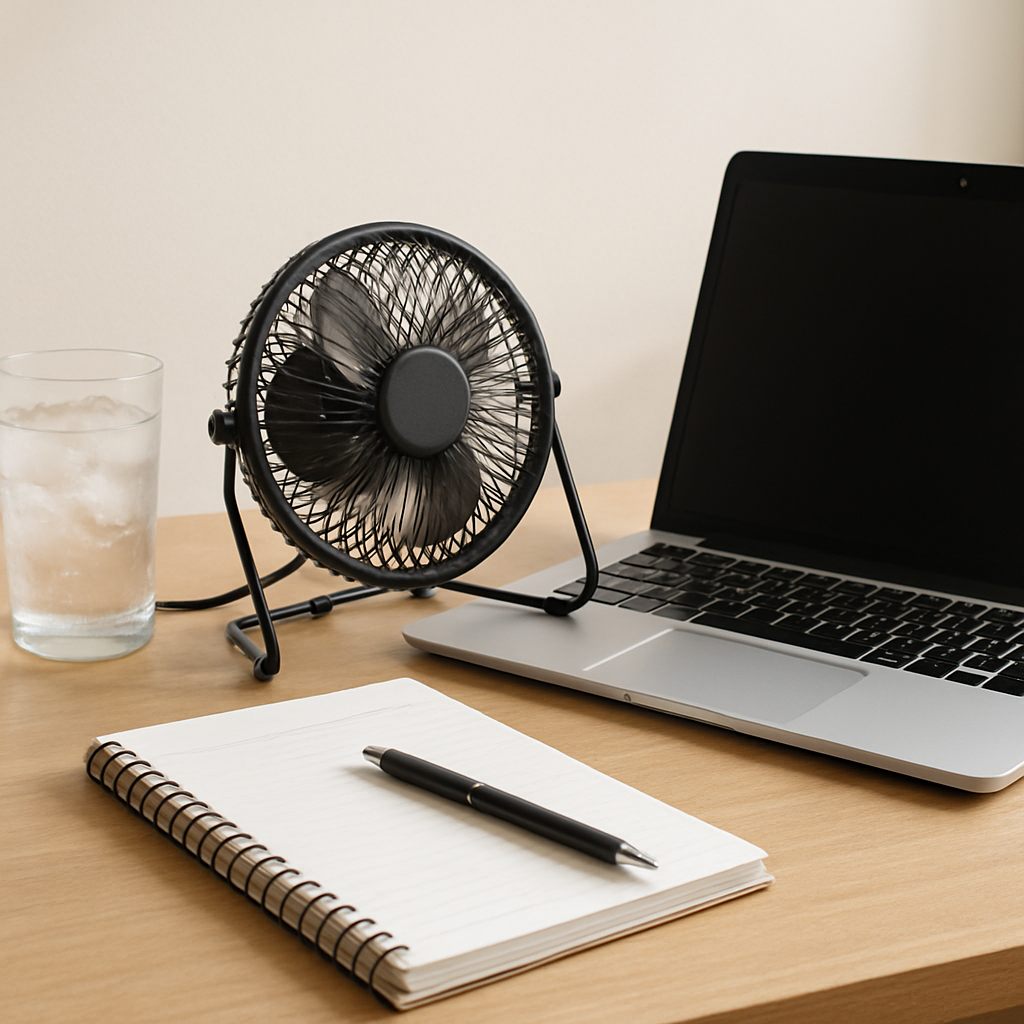
Aim airflow without drying your eyes
A USB desk fan should cool the person, not the whole office. Adjustable tilt, swivel, and stable feet matter because a fan pointed at the wrong angle becomes either useless or annoying.
For product picks after this setup check, review the LeStallion guide to 7 Best USB Desk Fans for Personal Cooling.
Choose quiet airflow over dramatic speed
The best personal fan feels steady during writing, calls, and focused work. Harsh motor noise, rattling grills, and pulsing airflow are usually worse than slightly lower power.
Keep the fan close, quiet, stable, and easy to clean.
Match USB power to your actual desk
Some fans run from a laptop port, wall adapter, monitor hub, or power bank. Check cable length and power draw so the fan does not steal the port needed for other accessories.
Keep the fan close, quiet, stable, and easy to clean.
Keep blades, papers, and coffee safe
A small fan still needs a safe footprint. It should not push papers across the desk, crowd the mouse, blow into a microphone, or sit where a coffee spill can reach the cable.
Keep the fan close, quiet, stable, and easy to clean.
Plan for dust before summer
Desk fans collect dust quickly. A removable grill, wipeable blades, and simple shape make the fan easier to keep clean without turning maintenance into a chore.
Keep the fan close, quiet, stable, and easy to clean.
Compare products after defining the seat
Once the desk, power source, noise tolerance, and airflow angle are clear, product comparisons become easier. The best fan is the one that cools consistently without taking over the workspace.
Keep the fan close, quiet, stable, and easy to clean.
How to test a USB desk fan before keeping it
Use the fan during the kind of work that overheats the desk: long spreadsheet blocks, video calls, afternoon writing, gaming breaks, or warm home-office sessions. A fan that feels good for five minutes may become too noisy after an hour if the motor has a buzz or the airflow pulses against the face.
Start on the lowest usable speed. Personal cooling works best when the fan sits close enough that it does not need to run aggressively. If it must be on high all day, the unit may be too small, badly angled, or placed too far away.
Notice what moves around the desk. Loose receipts, sticky notes, light napkins, and charging cables can make a small fan feel messier than expected. A stable base and focused airflow matter as much as blade speed.
Common buying mistakes
The first mistake is choosing the strongest-looking fan instead of the easiest one to live with. A compact desk fan should be quiet, stable, and simple. If speed changes require awkward button presses or the stand tips easily, daily comfort suffers.
The second mistake is ignoring the microphone. On calls, airflow across a mic can sound rough even when the fan seems quiet to the user. Place the fan off-axis from the mic and test one call before deciding it belongs on the desk.
The third mistake is forgetting cleaning. Dust on blades can reduce airflow and create stale smells. A fan that opens easily is often a better long-term pick than a sealed design that looks sleeker on day one.
One-week cooling routine
For the first week, use one speed and one placement during the same work block. Track whether the fan cools the user, distracts nearby people, moves papers, or adds cable clutter. Small adjustments are easier when only one variable changes at a time.
Try a morning setting and an afternoon setting. Many desks need little airflow early but stronger cooling when sunlight hits the room. A fan with predictable controls makes this routine easy to repeat.
At the end of the week, keep the quietest setting that still feels refreshing. Personal cooling should be almost invisible once work begins.
Final setup note
Write down the preferred speed, fan angle, power source, and desk position. That small record keeps the fan from becoming a daily adjustment ritual.
In shared spaces, ask whether anyone nearby hears the motor or feels stray airflow before mentioning the fan. Unprompted reactions show whether the setup is respectful enough for routine office use.
Deep-dive subpages
How to judge airflow without guessing
Set the fan on the actual desk and sit in the normal working position. The useful test is not how strong the air feels when held close to the face; it is whether the fan can make the whole work block more comfortable without drying eyes, moving papers, or creating motor fatigue. A slightly wider airflow pattern can feel better than a narrow jet because it cools the upper body more naturally.
Try the fan at keyboard height, monitor height, and off to the side. A side angle often cools the neck and arms without blowing straight into the eyes. If the fan has tilt adjustment, mark the position that works instead of changing it every afternoon.
For warm rooms, remember that a desk fan circulates air; it does not lower room temperature. Pair it with shade, hydration, lighter clothing, and safe cable placement. The best setup combines small habits rather than asking one tiny fan to solve the entire room.
What makes a fan easy to keep
A keeper fan disappears into the desk routine. It starts without fuss, stays put when bumped lightly, and can be cleaned before dust becomes visible. The controls should be reachable without looking under the stand or turning the unit around.
Check the sound in a quiet room. Some motors have a high buzz that becomes more noticeable than airflow. Others sound soft on low speed but rattle on medium. If the fan will run near a microphone, record a short voice memo with the fan on to catch problems early.
Also consider where it goes when not in use. A foldable or compact fan is helpful only if the hinge remains stable and the cable stores cleanly.
Related focus sound page
This cluster follows the previous HereNow guide on white-noise machines for improved focus. For product-level fan picks, return to the LeStallion USB desk fan guide.